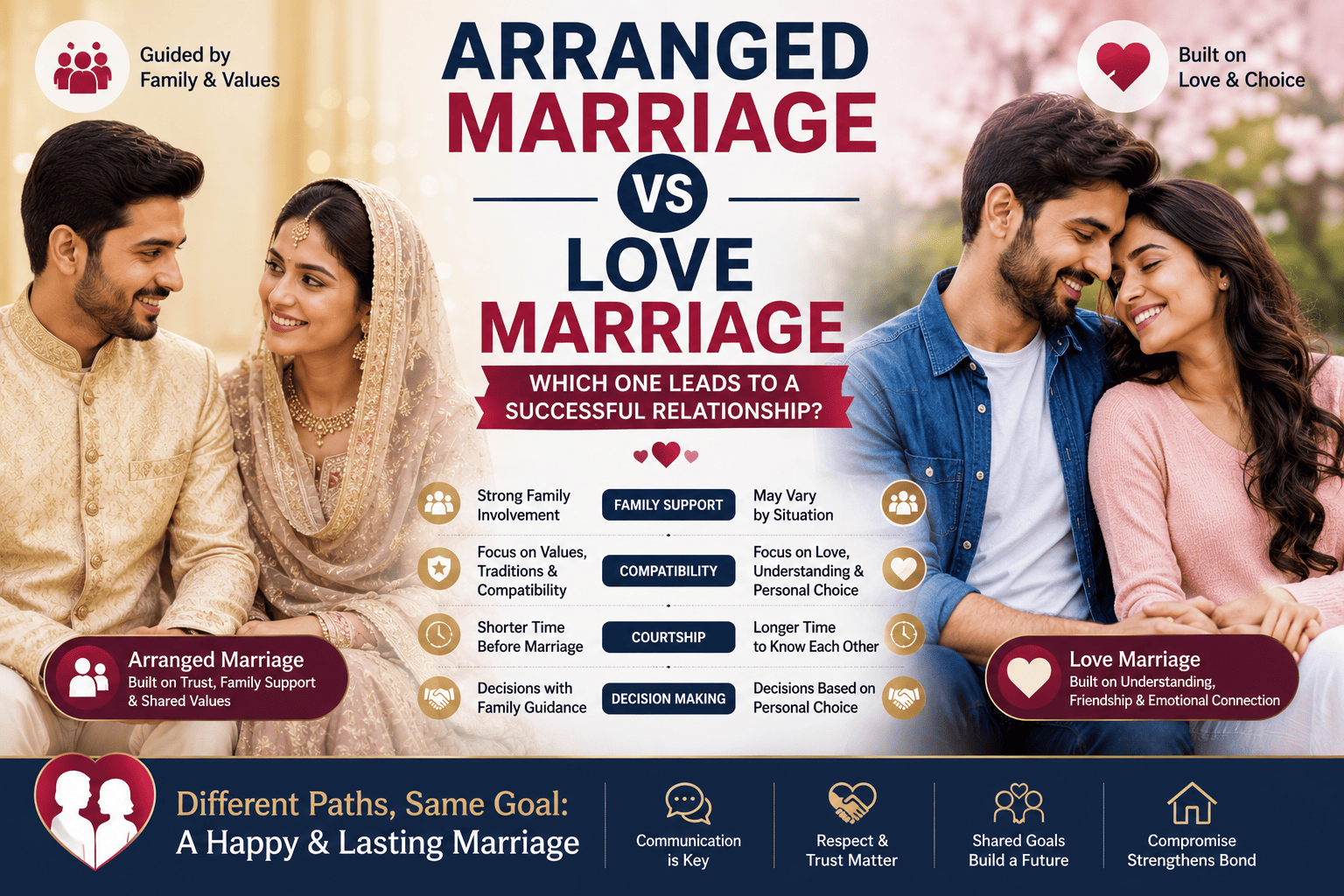
Marriage is one of life’s most significant commitments, and people enter it in different ways. Two of the most common approaches are arranged marriage and love marriage. While these paths differ in how couples meet and make their decisions, both have the potential to lead to happy, healthy, and long-lasting relationships.
Rather than asking which type of marriage is universally better, it’s more useful to understand the strengths, challenges, and factors that contribute to marital success.
This guide compares arranged marriages and love marriages to help you make informed decisions based on your personal values, goals, and circumstances.
What Is an Arranged Marriage?
An arranged marriage is a marriage in which families, relatives, trusted friends, or professional matchmakers help introduce two individuals who are interested in exploring compatibility for marriage.
In modern arranged marriages, the individuals usually have the opportunity to:
- Meet multiple times
- Ask questions
- Get to know each other
- Involve their families
- Decide freely whether to proceed
Today’s arranged marriages often combine family guidance with personal choice.
What Is a Love Marriage?
A love marriage begins when two people meet independently, develop a relationship over time, and later decide to marry.
Couples may meet through:
- School or university
- Workplace
- Friends
- Social activities
- Online matrimonial platforms
- Community events
The relationship typically develops before marriage through mutual understanding and shared experiences.
Arranged Marriage vs. Love Marriage: Quick Comparison
| Feature | Arranged Marriage | Love Marriage |
|---|---|---|
| How Couples Meet | Through families or matchmakers | Independently |
| Family Involvement | Usually high | Varies |
| Courtship Before Marriage | Often shorter | Often longer |
| Decision Process | Family guidance plus personal consent | Personal choice, often with later family involvement |
| Compatibility Assessment | Family values, background, goals | Emotional connection plus shared experiences |
Neither approach guarantees success or failure.
Benefits of Arranged Marriage
Strong Family Support
Families often play an active role in supporting the couple before and after marriage.
This support may include:
- Guidance
- Emotional encouragement
- Cultural understanding
- Practical assistance
Shared Values
Families often consider compatibility in areas such as:
- Religion
- Culture
- Education
- Lifestyle
- Long-term goals
Shared values can contribute to smoother communication.
Broader Perspective
Family members may notice practical considerations that couples overlook, helping both individuals evaluate long-term compatibility.
Challenges of Arranged Marriage
Some challenges may include:
- Limited time before commitment
- External expectations
- Pressure from relatives in some situations
- Adjusting to a new relationship after marriage
Open communication and mutual consent remain essential.
Benefits of Love Marriage
Emotional Connection
Couples often spend considerable time getting to know each other before marriage.
This may help build:
- Trust
- Friendship
- Communication
- Understanding
Personal Choice
Individuals generally have greater control over choosing their partner based on personal compatibility.
Shared Experiences
Having experienced life together before marriage can help couples understand each other’s strengths, habits, and communication styles.
Challenges of Love Marriage
Love marriages may also face difficulties such as:
- Limited family support in some cases
- Cultural or religious differences
- Unrealistic expectations
- Conflict if important issues were not discussed beforehand
Strong communication and mutual respect are important regardless of how the relationship began.
What Truly Makes a Marriage Successful?
Research and relationship experts consistently point to several factors that matter more than how a couple met.
Honest Communication
Healthy couples discuss:
- Feelings
- Expectations
- Finances
- Family responsibilities
- Future goals
Open communication helps resolve misunderstandings.
Mutual Respect
Respect for each other’s opinions, values, and individuality builds a strong foundation for marriage.
Shared Values
Successful couples often share similar views on:
- Family
- Children
- Finances
- Lifestyle
- Personal priorities
Perfect agreement isn’t necessary, but mutual understanding is important.
Trust
Trust develops through honesty, consistency, and reliability.
It is one of the most important elements of any long-term relationship.
Commitment
Marriage requires continuous effort from both partners.
Supporting one another during both challenges and successes strengthens the relationship over time.
Common Myths
Myth 1: Arranged Marriages Lack Love
Love can develop over time in arranged marriages through trust, shared experiences, and mutual respect.
Myth 2: Love Marriages Always Succeed
Love alone does not guarantee a successful marriage.
Healthy relationships also require communication, compatibility, and commitment.
Myth 3: Family Involvement Is Always Negative
Healthy family support can provide valuable advice and emotional encouragement while respecting the couple’s independence.
Myth 4: One Type Is Better Than the Other
There is no universal answer.
The success of a marriage depends more on the couple’s relationship than on how they met.
Questions to Discuss Before Marriage
Regardless of how you meet your partner, discuss topics such as:
- Career goals
- Financial planning
- Children
- Living arrangements
- Family responsibilities
- Religious beliefs
- Lifestyle expectations
- Conflict resolution
- Long-term dreams
Honest conversations help build a stronger foundation.
Tips for a Successful Marriage
- Communicate openly and respectfully.
- Listen carefully to each other.
- Resolve disagreements calmly.
- Support each other’s personal growth.
- Make important decisions together.
- Maintain trust through honesty.
- Continue spending quality time together.
- Appreciate each other’s efforts.
Frequently Asked Questions
Is an arranged marriage more successful than a love marriage?
There is no clear evidence that one type is inherently more successful than the other. Success depends on communication, compatibility, trust, mutual respect, and commitment.
Can love develop after an arranged marriage?
Yes. Many couples report that love grows over time as they build trust, share experiences, and support each other.
Should families be involved?
Family involvement varies by culture and personal preference. Many couples benefit from supportive family relationships while maintaining their own decision-making.
Which type offers better compatibility?
Compatibility depends on the individuals involved rather than the method through which they met. Honest communication and shared values are key.
Is counseling helpful before marriage?
Many couples find premarital counseling beneficial because it encourages discussions about expectations, communication, finances, and future planning.
Final Thoughts
Arranged marriage and love marriage are two different paths that can both lead to fulfilling, lifelong relationships. Neither approach guarantees happiness, and neither should be judged as universally superior.
The strongest marriages are built on trust, respect, open communication, shared values, and a willingness to grow together. Whether you meet through family introductions, friends, or an online matrimonial platform, investing time in understanding each other is far more important than how your relationship began.
Choose the path that aligns with your values, respects your independence, and supports a healthy partnership based on mutual understanding.